
Author: Ella Fosse
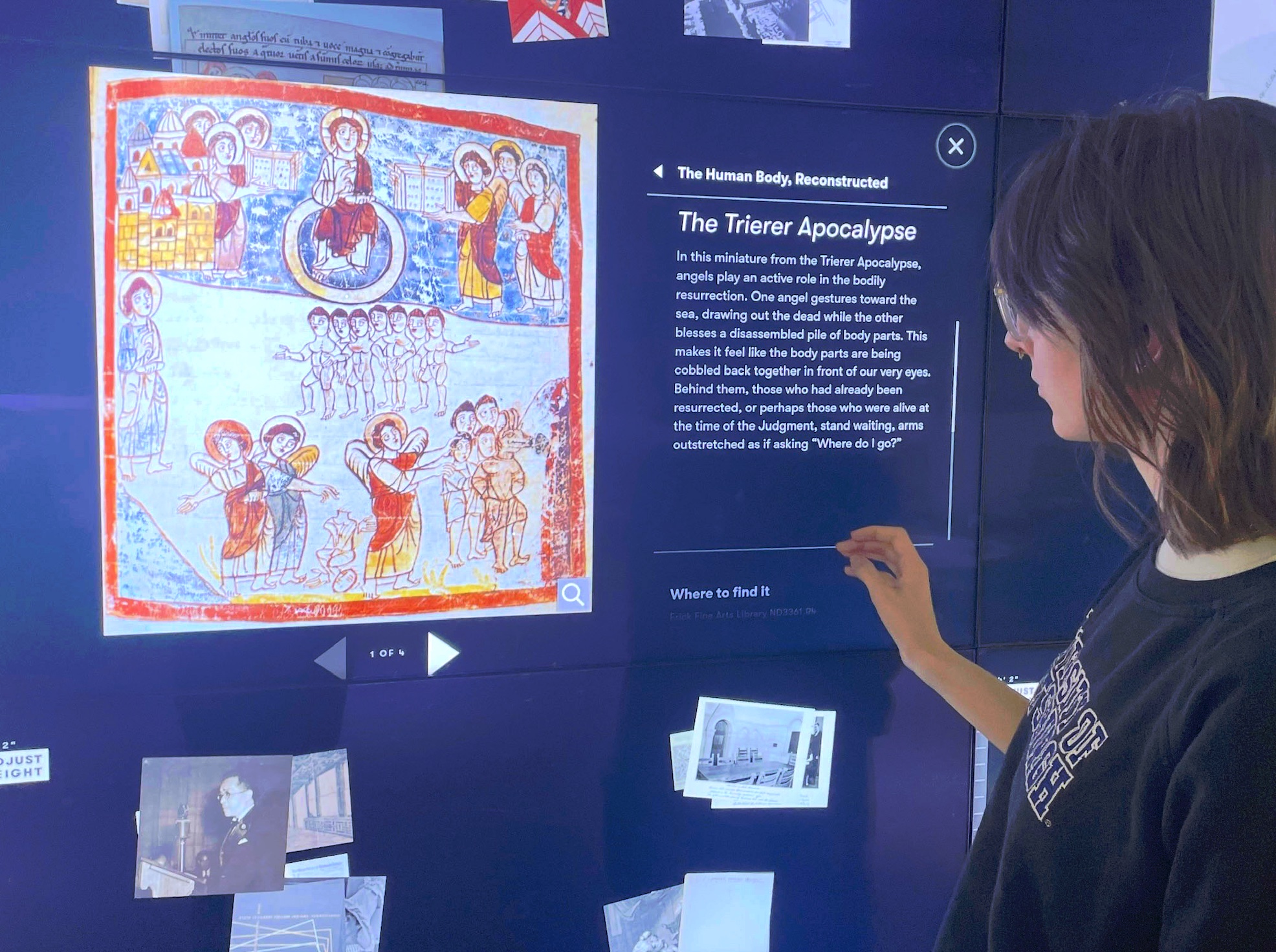
Picture this: the dead crawl out of the earth, some with burial shrouds still intact. They claw their way to the surface, emerging out of their deep graves to gather in large numbers. Some of their comrades come back in fragments, arms, and limbs that were previously scattered, cobbling back together to make their rightful owner whole again. Is this “Night of the Living Dead?” You’d be surprised to find that depictions of the Christian Last Judgment in art contain bizarre scenes like this and more. I spent my semester looking at depictions of this Biblical scene in facsimiles of illuminated commentaries on the Apocalypse held by the Frick Fine Arts Library thanks to the Archival Scholars Research Award (ASRA). I was mainly interested in how the resurrection of the body was portrayed. The Book of Revelation 20:13 states that “the sea gave up the dead that were in it, and death and Hades gave up the dead that were in them,” but what does this actually mean? This project was an attempt to reach back in time and ask illuminators of manuscripts and their writers what they imagined coming back from the dead would actually look like.
My interest in this topic was inspired by a decorated table depicting the Last Judgment by the painters Nicolaus and Johannes held by the Vatican museum’s Pinacoteca. A section of the table contains a scene of resurrection that is anything but typical: arms and legs come out of the mouths of fish, tigers, and deer, as if the animals were forcibly regurgitating remains of humans that were returning to their original bodies for judgment. This scene resurfaced during my brainstorming for research questions, and it evolved into an inquiry on the depiction of the physical body during resurrection as they appear in the illuminated manuscripts that the ULS has in its collections.
Originally, my research was meant to be focused solely on the miniatures (the larger illustrations in the text) featured in the manuscripts, specifically on those depicting the Last Judgment. I certainly had a lot to parse through, as the Frick Fine Arts Library has several full-size facsimiles of apocalypse manuscripts. The difficult part in the beginning was actually finding the Last Judgment pictures in the first place. For many of the manuscripts, I flipped through the manuscript first before diving into the accompanying text explaining many of the miniatures. This may have been the reverse of what my process should have been, as I was not actually all that familiar with the Book of Revelation. I kept thinking “Ah, surely this one’s the Resurrection,” when it was really just the mountain being thrown into the sea. As time went on, I grew more familiar with the common motifs of the Judgment, so it got better.
I found lots of images that were prime material for observing conceptions of bodily resurrection. Most were relatively normative, portraying naked bodies with their feet in water to indicate that they were coming out of the sea. A few later texts, such as the Trinity College Apocalypse, depicted people coming out of a dark Hellmouth that might have indicated purgatory. Some motifs stayed constant, specifically the naked bodies and the appearance of the Book of Life. Some miniatures only portrayed men, whereas others depicted men, women, and even children being judged in this end-of-days event. One apocalypse manuscript, the Morgan Beatus Apocalypsis, did not even contain a scene of resurrection, choosing instead to use the space for a bureaucratic scene of judgment by saints and other holy heroes. Out of all of the miniatures I studied, my favorite by far was the Trierer Apocalypse’s Last Judgment (pictured above). This early Carolingian miniature is unique in almost every aspect, but what really drew me to it was the Resurrection imagery. One angel gestures toward the sea, drawing out the dead while the other blesses a disassembled pile of body parts. This almost makes it feel like the body parts are being cobbled back together in front of the viewer’s very eyes. This kind of unique resurrection that evokes such a strong sense of action and movement was exactly the kind of thing that attracted me to seek out these depictions in the first place, so I was so glad to come across it.
Despite the project starting out as focused on the content of the miniatures only, I was pleasantly surprised to find that the apocalypse commentaries had a strong textual component as well. While I initially thought that these miniatures were only accompanied by the Biblical verse it depicted, there is actually an element of interpretation done by monks attempting to explain exactly what is happening during this event. Due to this, I was able to find insights on exactly how people were thinking about this resurrection. I was able to find two lines of thought on the subject. The monk Beatus of Liebana, whose commentaries appear strongly in the Spanish monastic tradition, suggested that the “sea” could mean the physical realm broadly or be a literal claim that people who had died at sea would come out of it. He also claimed that people would come back in the exact same body they had when they were living. Another monk, Berengaudus, claimed that the sea referred to the spiritual sea of baptism. It was incredibly cool to have the monks’ own words on the subject rather than only conjecturing based on the illustrations of the commentaries.
Overall, the process of doing an ASRA allowed me to finally delve into research at Pitt. I am incredibly grateful to my mentors, Dr. Maxwell, Rachel Lavenda, and Anais Grateau for all their help on this project. Throughout the process they were always there to offer input and advice on my project, and it would not have been possible without them. My semester of research culminated in an event where I had a lovely conversation with a fellow ASRA scholar discussing our research followed by the opening of the ASRA Digital Wall Exhibit in the Archives and Special Collections Gallery on the third floor of Hillman. If you’re interested in seeing my work, I highly recommend checking it out!