
Author: Julia Bowe
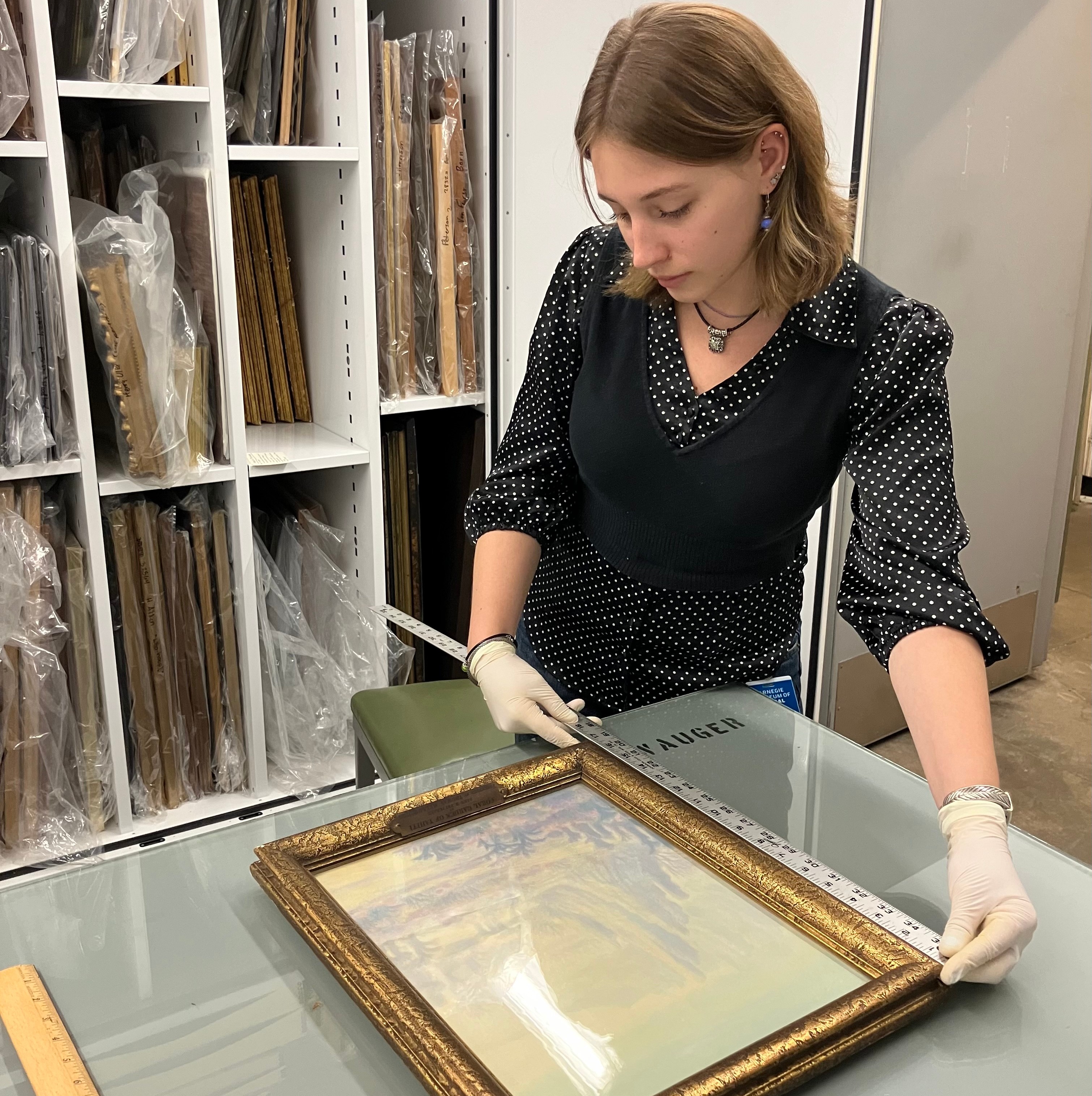
There was nothing more captivating than knowing that the artwork in my hands was painted at the bottom of the ocean. The Carnegie Museum of Natural History has an art collection with many creations depicting the natural world, including a painting by Zarh Pritchard titled, Coral Garden in Lagoon of Maraa, Tahiti in Twenty feet of water (1922). This artist took painting in plein-air to the extreme by recreating the dreamy, pastel-colored seascapes while submerged underwater. I felt a sense of wonder with the artwork right in front of my eyes and between my hands. Pritchard had beautifully captured the hazy atmosphere of a sunny lagoon and the soft pink and turquoise of the coral. When I really leaned in, I could see the peach-fuzz quality of the chamois that the scene had been painted onto. The impact of the object’s aura was elevated further after I conducted research on the artist and found that he was the first to paint underwater like this amongst the anemones and the fish. Any art-lover has experienced the rush of energy, the sensory pleasure, and the uncontrollable gasp let out when face-to-face with a beloved artwork. Sometimes this feeling arises just knowing that the artist has held this object in their own hands, shaping it into their vision – we feel close to them through the object itself.
The best way to get to know an object like Pritchard’s is by spending time in its physical presence; that is the privilege of working with collections and archives in museums like CMNH where I interned this fall under the supervision of Assistant Curator, Deirdre Smith. What is ironic is that one of my central projects was to work towards digitizing the collection – making it visible and accessible digitally for people like scholars, curators, and students. This position allowed me to act as a bridge between the object and the world. I got to physically handle and observe Coral Garden, recording its metadata, storage condition, and formal qualities. Then I researched Pritchard himself and compiled the historical context of the painting for further interpretation and use by others. However, I realized that the digital images and descriptions of the objects in the collection could never entirely replace the objects themselves. This is not only true of the beautiful formal qualities of art, but also their irregularities and the challenges that arise when managing the collection. It’s just as valuable to discover penciled markings, scribbled notes, and strange stamps and stickers on the back of an artwork, even tattered edges and old frames. These details help tie the object to the humans who created and worked with it, giving me a better view into the past. And they have the potential to both clarify and complicate its history. The good, the bad, and the ugly all make up the aura of an object.
While digital imaging and inventory have real practical implications, the sense of scale, texture, weight, vibrancy, and even smell of objects is best absorbed in person. In my time with CMNH, I simultaneously fostered a commitment to accessibility of art, history, and culture and affirmed my passion for corporeal experiences with art objects. These aspects of museum work, I learned, are not in competition with one another, but enhance one another. Both provide lessons that will continue to enrich my academic and professional endeavors in the years to come.
Julia Bowe was a Museum Studies intern at the Carnegie Museum of Natural History, Fall 2024