
Author: Oliver Petersen
Did you know that the Carnegie Museum of Art has a collection of 19th and 20th century wallpaper? Well neither did the Carnegie Museum of Art! In 2017, a lonely box was discovered in the Heinz Architectural Center’s collections storage containing 38 wallpaper samples, with absolutely no information inside regarding the origins, era, or provenance of any of them. Though this may seem highly unusual, FIC, or ‘Found in Collection’ objects are found periodically in all institutions with collections as large and old as the Carnegie, with the CMOA in charge of the care and organization of over 100,000 objects, collected over 130 years! It is slightly unusual, however, to find FIC objects so divorced from an existing collection, as the CMOA has not routinely collected wallpaper, with not a single roll or sample found in their online database.
For my internship this semester, I was brought into the conservation lab under photo and paper conservator Jessica Keister and Senior Manager of Conservation Mary Wilcop to act as both a detective and a conservator, tasked with researching the origins of this mysterious group of beautiful objects forgotten by time. It was also my responsibility to clean, mend, and rehouse them so that they may live to see another century, and maybe someday be part of an exhibition.
Opening their gray plastic bin for the first time, I held my breath, unsure of what was in store. The only photo that had been taken of any of the rolls when they were found was small and blurry, but its bold colors and art deco design made me hopeful that I might find papers as old as the 1930’s. Instead, as I pulled out roll after roll and began my research, I was shocked to find a timeline of paper far wider, and far more historically important, than I ever could have imagined. More specifically, this collection not only represents a timeline of 60 years of wallpaper history, beginning in the 1880’s and extending into the 1940’s, but also a presentation of over half a century of art and home decor trends – spanning art nouveau, arts and crafts, and art deco - beginning around the time that wallpaper production was industrialized and became accessible for almost all American homes.
The process of dating each wallpaper ranged in difficulty, as some papers contained manufacturer names, patent numbers, or catalog numbers that allowed for a place to start, while others contained nothing but ink and dirt. Even with the few in which manufacturers were named, it was still often hard to dig up much, as many companies existed for as little as a decade in the early 20th century and have left almost no digital or archival footprint. One sample from a particular manufacturer, Standard Paper Co, I was only able to date approximately from a postcard found on Ebay picturing the company's factory from 1917! As my research deepened, I was able to put together a timeline based on what sure information I could find online, supplemented by inferences made by looking through wallpaper sample books and the collections of institutions like Cooper Hewitt. The oldest in the collection, which I believe to have been made in the 1880s, was produced only a handful of decades after the industrial wallpaper process was created in the 1840’s. The majority of the samples come from the early 19th century up until around the 1940’s. Wallpaper designs such as these were pasted in hallways, kitchens, bathrooms, bedrooms; on walls, ceilings, and baseboards, popular in both the wealthiest and poorest homes.
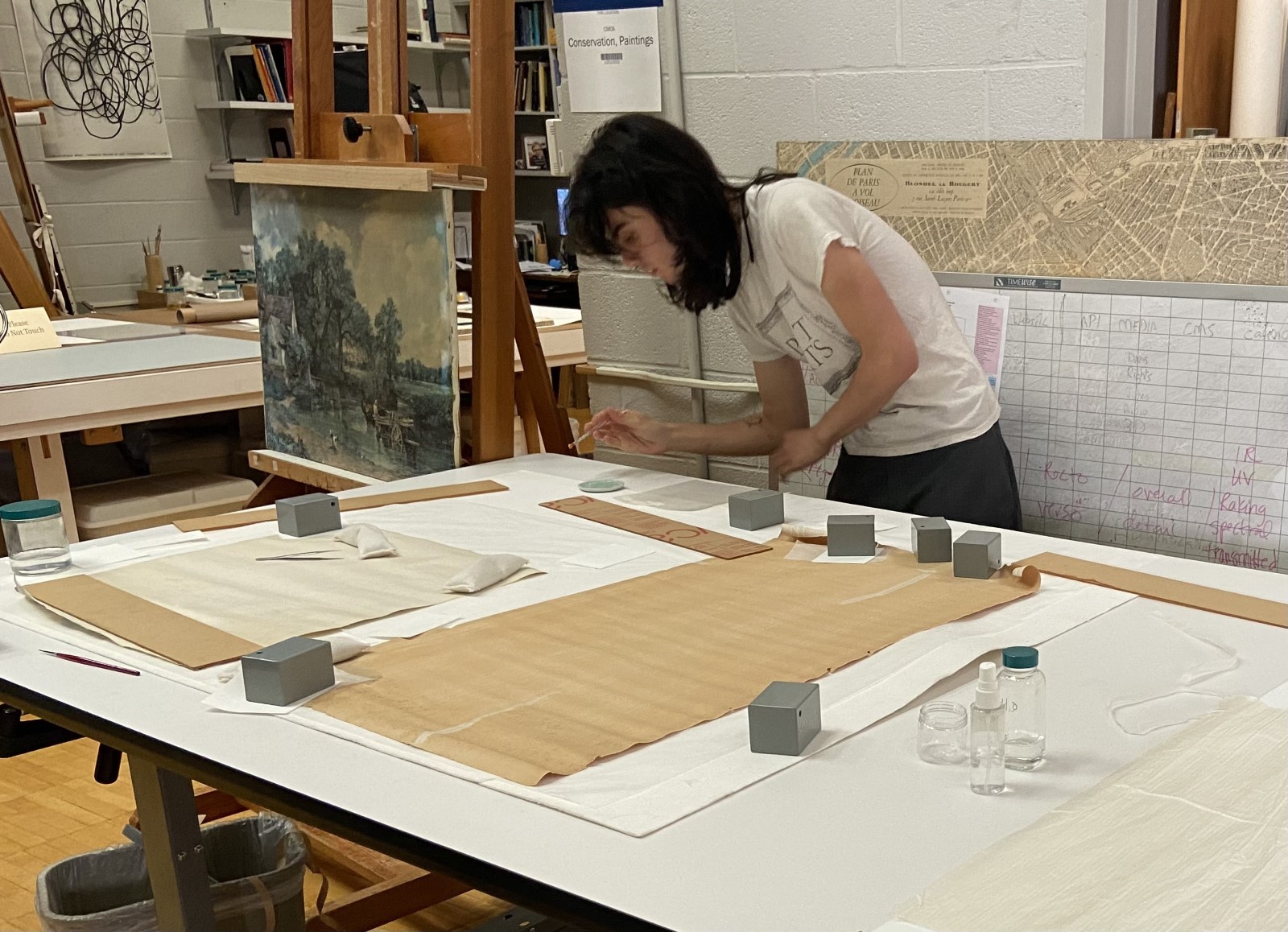
Some of the wallpapers were unfortunately in pretty bad shape, as the thin wood pulp paper they were printed on is prone to become very brittle over time, and many had been exposed to water damage. However, this poor condition allowed me to get lots of hands-on conservation experience. I first surface cleaned the paper using makeup sponges and eraser crumbs, which was tedious but quite satisfying. Then, I was taught how to make my own conservators paste and used it to mend tears of all 38 papers using strips of mulberry paper. This was by far my favorite part of the process, as some of the tears were quite extensive, and while repairing them I was able to watch the objects come back to life in real time. It was also so much less nerve wracking to handle the papers after they had been mended and stabilized, which was much appreciated. The next step was to humidify and flatten the wallpapers as many had been kept in tight rolls for over a century. To do so, the papers were placed in a humidification chamber and monitored until ready to be placed between blotters under gentle pressure. Lastly, we rehoused the wallpapers in a custom made folder, ready to be safely stored back in collections until hopefully they are one day chosen for exhibition.
Unfortunately, despite months of looking through museum records, sample catalogs, patent records, and wallpaper history books, I never was able to find out how these beautiful papers ended up at the CMOA. Anti-climatic, I know. However, this project was certainly not undertaken in vain, as I not only learned many conservation techniques and skills in preparation for graduate school and beyond, I was also given the opportunity to do a deep dive into a much-overlooked medium and do my part to help preserve it. Wallpaper was once a ubiquitous part of almost all American homes after the industrial revolution, acting as a reflection of trends in design history over centuries, but is not often given much thought in contemporary times. Though these papers were not block printed on fancy paper, or hand painted, or imported from China, or once pasted on the walls of a mansion, they represent a very influential period in which the average person could, for the first time in history, access the decorative arts to such a degree that they could afford to cover not only their walls but also their ceilings and baseboards of whichever rooms they pleased. And that I consider to be very important.