
Author: Adaline Cooper
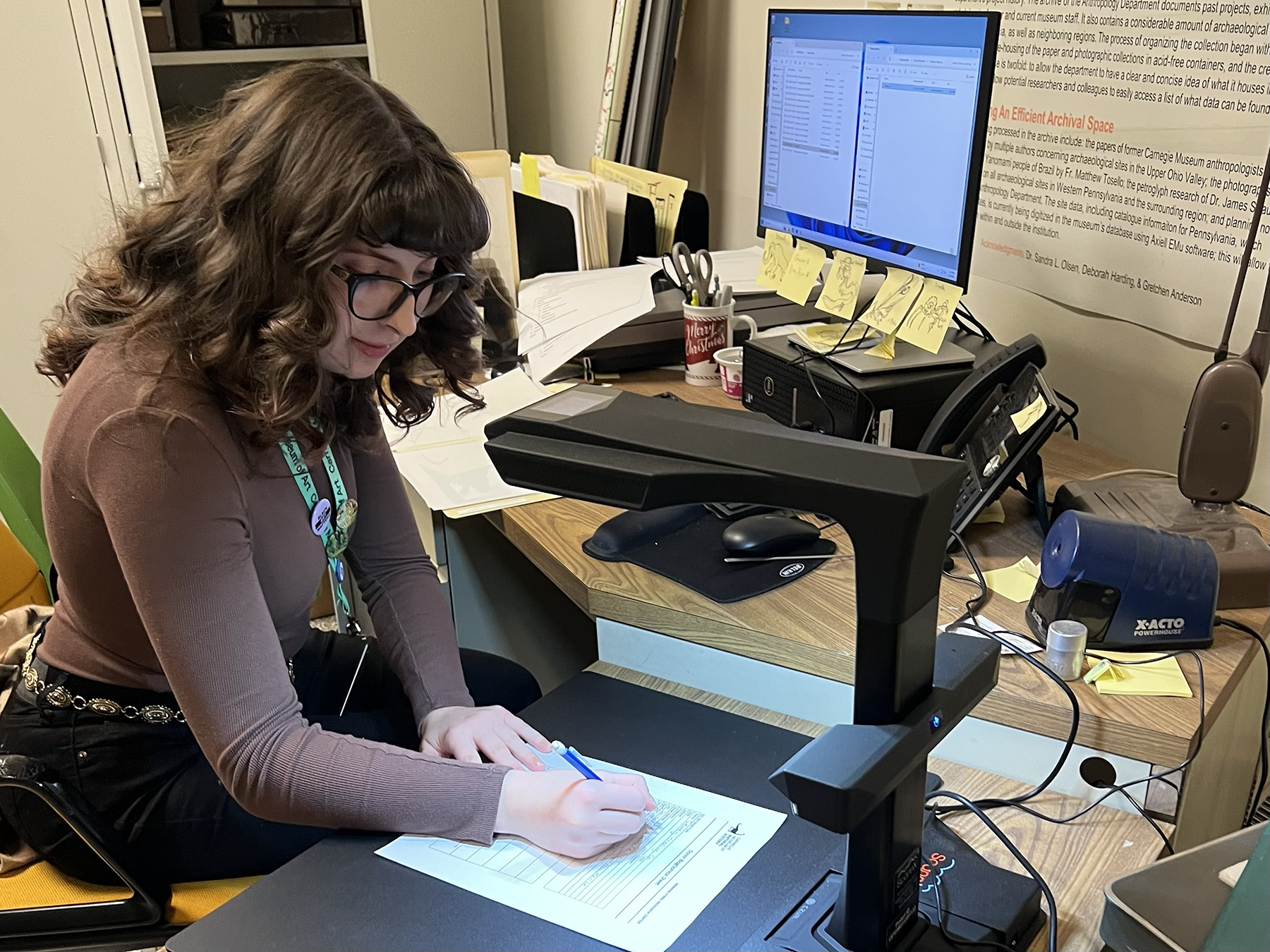
When I learned that the task that my supervisor had set out for me was to organize and digitize the donor files, I had no idea what any of that meant. However, working on this project has been one of the most rewarding career-oriented experiences I have had so far.
Within the first few weeks of my project, I opened a particularly interesting file filled with letters and newspaper clippings. I started to read the near century-old letter in my hands, parsing it for simple information that I could sort and write down—the donor’s full name, address, occupation, etc.—and instead, I discovered a fascinating story. This letter was frantically written by a woman who was intending to donate an ancient Egyptian artifact to the Carnegie Museum. She claimed that the item was cursed and wrote that her possession of it had led to the unfortunate deaths of two members of her family.
Startled, I continued scanning through this correspondence, searching the dates to find the next letter in the chain. When I found it, I eagerly read the reply. The director of the museum at the time had responded to her, assuring her with a touch of humor that if such curses had truly existed, he would surely have died already. This fascinating and superstitious conversation is just one of many incredible stories that are hidden deep in filing cabinets, but if they were made more widely accessible, then perhaps their insights into the way people interact with objects can be made clearer. Beginning in January of 2026, I started an externship with the Carnegie Museum of Natural History, specifically within their Anthropology department. My project was taking place at a collections storage center and research facility for the museum, led by my supervisor, Kristina Gaugler, the Anthropology Collection Manager for the Carnegie Museum of Natural History. When I learned that the task she wanted me to begin was working with paper files filled with information about the collection’s many donors, I had no idea what to expect. Working in archives and collections is something that I have always been interested in, but before this externship I didn’t have any experience in the field. The kinds of things that I discovered when I flipped through the files were incredible, and they are full of so much important archival information that I instantly knew why the digitization of these donor files was such an important task.
The donor files consist of any and all available information on the people that donated objects to the collection, and the objects that were donated. Official forms, receipts, letters, websites print-outs and email chains, post-it notes left by museum staff, photographs, cassette tapes, and so many more forms of media are to be found in these folders. Organizing these files with a checklist that instantly tells any potential researchers what kinds of information they can find within is a way to immensely speed up the research process. In addition, scanning these files is the first step towards creating a searchable database that could be accessed online, allowing for researchers across the world to gain access to this incredible information.
The mission statement for the Carnegie Museum of Natural History is “to deepen wonder and advance understanding of our natural world—past and present—in order to embrace responsibility for our collective future.” I feel incredibly lucky that I have been able to play even one small part in furthering this mission by improving a system that is now able to be more effectively utilized by researchers.