
Author: Matthew McCullough
In the age of information and digitization, the Carnegie Museum of Natural History is still catching up to ever-evolving standards of collection storage. Museums collect across a wide range of artistic, cultural, and scientific history. All of these objects need special care and attention to preserve them for future viewing and research. This work now also includes digitizing acquisition forms, loans, and any documents pertinent to the museum’s history and mission.
This semester I had the pleasure of working in the Edward O’Neil Research Center (EORC) with Amy Covell-Murthy and Kristina Gaugler. Amy is the Archeology Collection Manager and Head of the Section of Anthropology. Kristina works as the Anthropology Collection Manager at the CMNH. They taught me how the museum is improving and evolving its collection management methods to be more efficient and respectful to those whose cultural artifacts reside there.
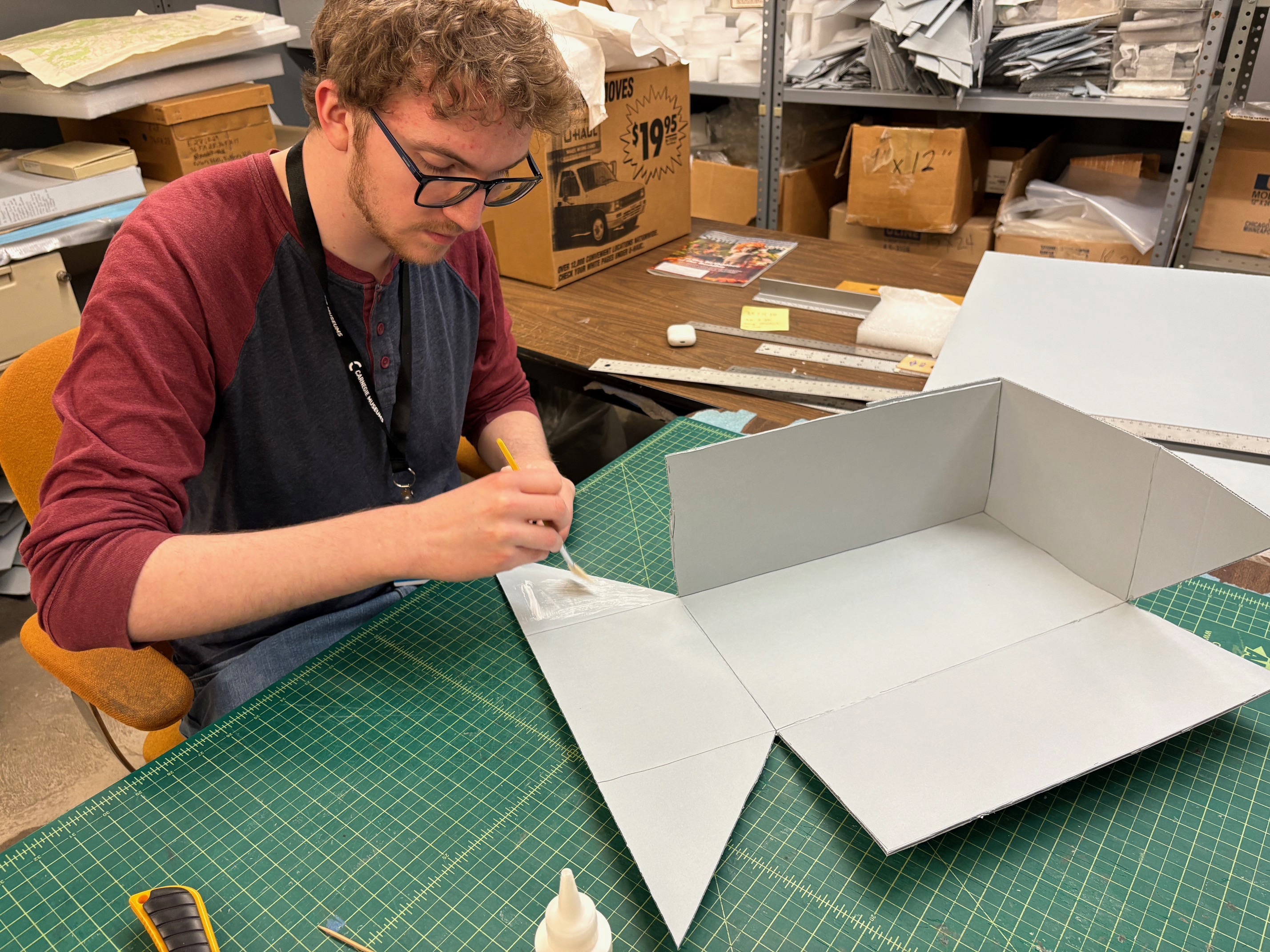
When I arrived on my first day at the EORC, I familiarized myself with the building and its contents. My first tasks were to help enter old loan cards into our database as well as assemble new archival boxes. These boxes aren't just flimsy cardboard and plastic, but blue corrugated boxes made to prevent harmful substances and acids from damaging artifacts. Boxes made from this material are assembled in varying sizes to preserve archeological artifacts for many years.
The building itself is climate-controlled by the central HVAC system and helps create a stable temperature that improves environmental conditions. Furthermore, there are microclimate boxes created for some artifacts that need additional care. These boxes have silica gel trays that act as drying agents to maintain the desired relative humidity. Not too long ago, the museum tried to reorganize, reuse, and renovate storage spaces and mounts by installing new storage furniture and making a more efficient and accessible environment.
My main project for the externship was to finish the long-term project of cataloging and storing the last of the artifacts found at the Johnston site, an excavation conducted by Indiana University of Pennsylvania anthropology students from 2006 until 2012. By individually bagging artifacts and organizing them into labeled blue corrugated boxes, I saw firsthand how efficiently these boxes utilized space in the new storage cabinets. Convenient access to these collections makes everyone’s jobs easier and helps researchers clearly find what they need.
The Carnegie Museum of Natural History has had a profound impact on the city of Pittsburgh as well as the archeological sites found in Western Pennsylvania. Here, in the EORC, is where many of the original documents, notes, and artifacts from the first excavations in this region call home. I am glad to have played a part in guaranteeing the longevity of its collections and history.