
Author: Anya Hammer
Wandering through a gallery is an almost universal experience. It is difficult to imagine such spaces, typically seen with wall-hung paintings, statues, and objects in display cases, with their little labels and descriptions alongside them, vacant of such content. My introduction to the Frick Pittsburgh began in one of these gallery rooms, emptied of its contents. Their Scandinavian Home exhibition had just closed, and the works had been sealed away in specially made wooden boxes, save for a couple of large pieces: three wooden panels with relief illustrations of Genesis, a leather-topped wooden desk with stained glass details, and something that we had dubbed “the Troll cabinet”, made of blue-green painted pine with metallic carvings of Scandinavian folklore and trolls.
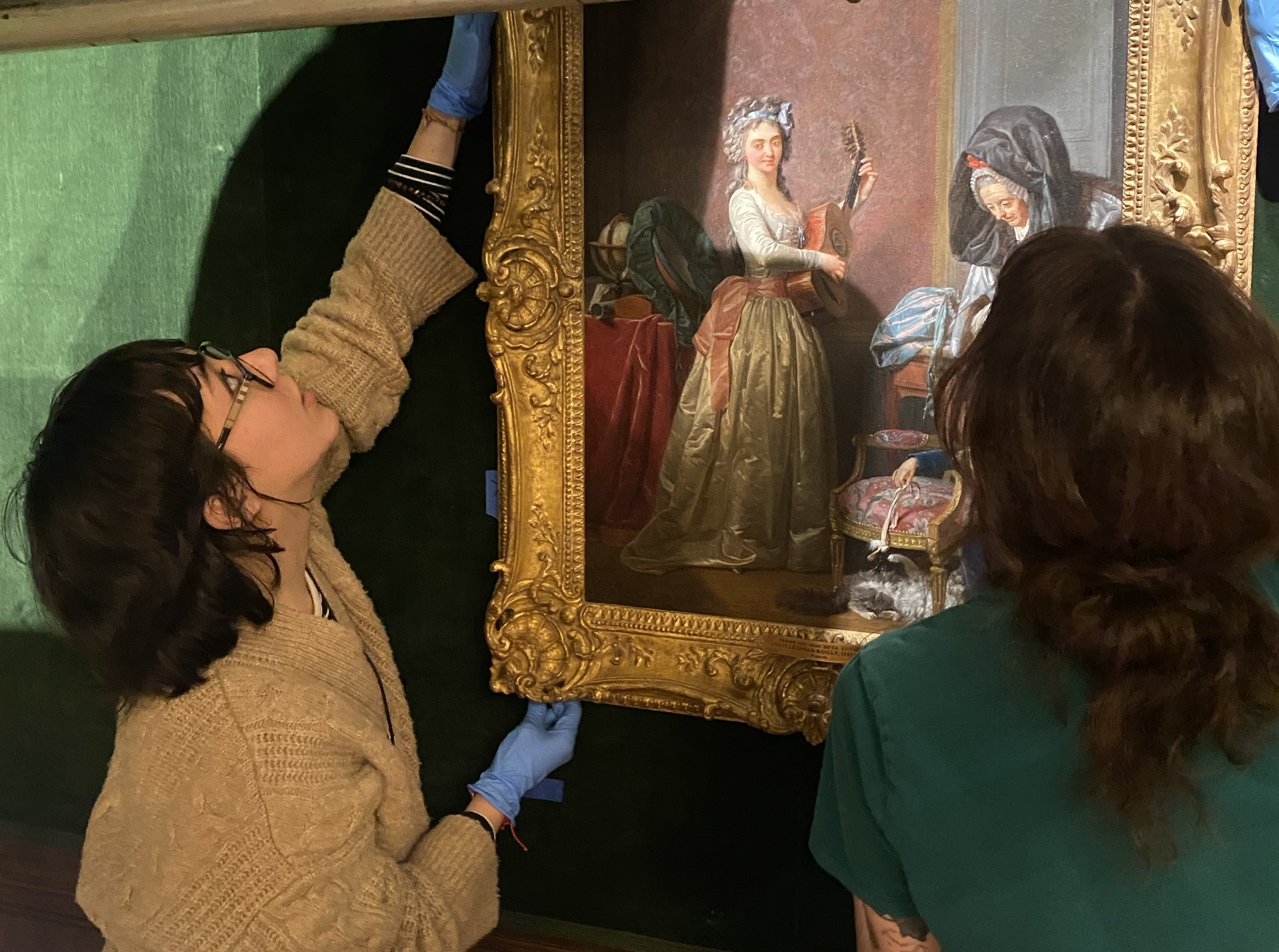
Over the days, we carefully took these pieces down, one by one, leaving the gallery increasingly bare. Where the panels were, there remained only a floral, salmon-colored wall, and where the stained-glass desk was the raised platform it sat on, seemingly purposeless without its occupant. The lack of objects drew attention to what needed to be fixed: holes from hung works, vinyl text that needs to be peeled, and the several dozen crates filled with art, stored in the preparation room until they are collected for transport. These empty rooms would be filled with art again, almost immediately. The green room, dubbed for its vibrant velvet walls, needed to have its works from the Frick’s permanent collection back on its walls. Sitting on little blocks of foam, protecting the frame of these works from the floor, each painting was positioned in the spot it needed to be hung. One by one, working with professional art handlers, I helped lift each painting so that it could be reinstalled.
With these rotating exhibition spaces cleared out, they sat ready to house new residents. Thus, our installation of Lewis Hine Pictures America began. With over 70 photo prints arranged for exhibition, these arrived in two modestly-sized crates, sitting for two days to fully acclimatize to the museum. As they sat, the walls of the galleries were repainted in orange and grey, chosen by Lauryn Smith, the museum’s Assistant Curator, colors much more suitable for black and white photographs than the salmon that covered the rooms before. These photos were then examined by the collections manager, my supervisor, Christina Cichra, as she made condition reports observing scratches or warping in the prints. For this exhibition, I was tasked with preparing the labels that accompany every work in the exhibition.
Since supporting the turnover of these exhibitions, I have been continuing to assist in the management of the Frick Pittsburgh’s collections in both the mansion and the museum. We have catalogued and photographed beautiful leather-bound books, filled with annotations from the Fricks and discovered boxes of old perfume hidden in the attic. Having grown up only two blocks away, the opportunity to contribute to a museum I have known for my whole lifetime is a dream come true.