
Author: Jordyn Barnes
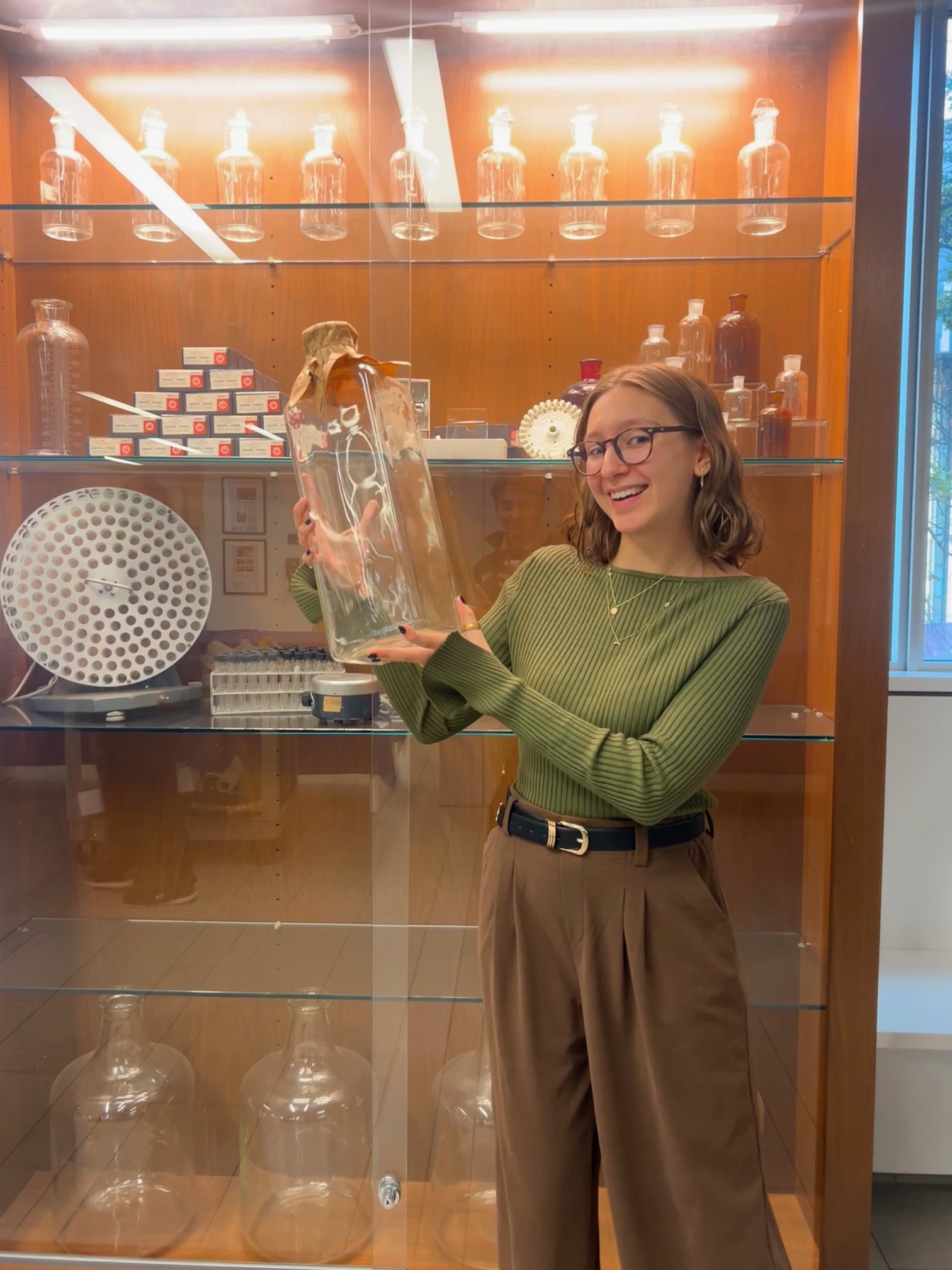
In my time with the Jonas Salk Legacy Collection, I have experienced the life and legacy of Jonas Salk in a unique way – I discovered the equipment used to create the polio vaccine before truly understanding the actual vaccine development process. My pursuit of a microbiology degree alongside a museum studies degree has led me to be quite familiar with modern labware and scientific processes. Much of the technology I encountered as I catalogued the collection in storage was nearly identical to what I might see today: beakers, graduated cylinders, microscopes, and test tubes, for example. Centrifuges were larger and held fewer samples, but were still recognizable. Plenty of equipment in the collection is outdated, such as a Polaroid camera attachment for taking photos of microscope slides. Seeing the evolution in physical equipment made me wonder about the evolution of vaccine development and best practices when conducting field tests of new medicines.
To learn more about the development of the polio vaccine, I consulted my mentors, information already available in the Jonas Salk Legacy Exhibit, and scientific papers written by the Salk lab. Even though a 5-year timeframe seems quick for a vaccine that would soon be used globally, Salk and his team had an intense attention to detail when it came to creating a safe and effective vaccine. Out of this dedication came numerous practices scientists still use today. One researcher with the Salk team, Julius Youngner, discovered that using the trypsin enzyme to degrade cell-to-cell links allowed researchers to culture a thin layer of cells rather than clumps of tissue. Today, cell cultures made in this way are used in a variety of cases such as cancer research and pharmaceutical testing. Many biographers will detail Salk’s life, but very few discuss the work that went into the polio vaccine.
To the average person, the word “science” can be uniquely intimidating. There are so many ways to interpret the world, and those methods are filled with complex processes that only the highly and specifically trained can understand. The responsibility falls upon educators and professionals of all kinds to dispel fears and concerns about things we don’t understand. That is one of the key missions of the Jonas Salk Legacy, to educate the public about both Jonas Salk’s work and vaccine development in general. The creation of the polio vaccine was a publicly funded research project by the March of Dimes. The polio vaccine was confidently believed to be so safe and effective that Salk tested it on his own children. Today, the federal government pulls funding from more essential health research while parents choose not to vaccinate their own children. Through the display of lab equipment, an iron lung, and informational texts, the Jonas Salk Legacy aims to educate the public and dispel fears about complex vaccines. As a microbiology student, I am almost always being educated about a new and complex topic. As a museum studies student, my main takeaway has been that it is our responsibility to educate both ourselves and others, and my time with the Jonas Salk Legacy Collection has only amplified this sentiment. Hopefully, every person who chooses to interact with our displays will walk away with a little more knowledge and a little more confidence in the world.