
Author: Anuja Kumbhardare
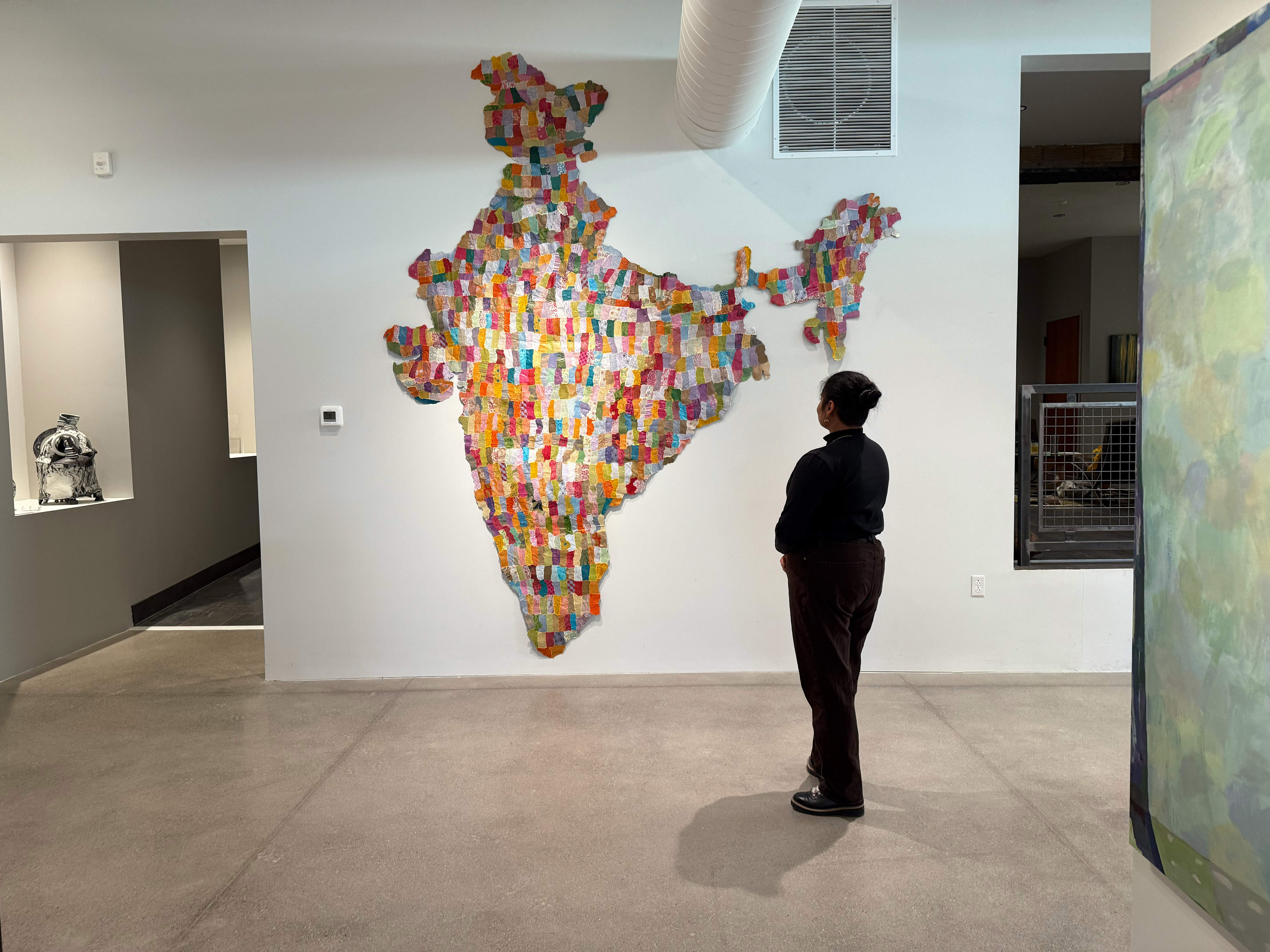
Walking into the Malta Foundation, I never expected to find an image of India hung prominently on the wall. Made by Pittsburgh-based artist Diane Samuels, Midnight’s Children, Salman Rushdie (2014) is an eye-catching piece with many latent narratives. The journey of researching this work of art has been a snapshot of many of the lessons that my internship at the Malta Foundation has taught me this semester.
This process began with synthesizing biographical information about artists’ lives, processes, and work through online research. I then conducted a visual analysis of the piece: patchworking 1001 pieces of paper to form the map of India as it was drawn on August 15, 1947; Samuels’ hand writes out the entirety of Salman Rushdie’s namesake book in the minuscule script. The date corresponds to the day India gained independence from the British, and the 1001 pieces correspond to the 1001 children born within the first hour of India’s independence, which, in the novel, gives them magical powers.
At first glance, I thought that much of the piece was made with symbolic purposes in mind. I interpreted the colorways as intentional choices to reflect popular Indian colorways. I saw the pattern on the paper emulate traditional woodblock printing styles. The use of patchwork was recalling the conditions under which India’s independence was forged and the chaotic unity of different people with different languages, religions, politics, traditions, and cultures.
Later in the research process, I had the opportunity to contact Ms. Samuels and interview her. She was kind enough to agree to a studio tour, and walking around her workspace was an experience that I will never forget. However, after interviewing Ms. Samuels, she revealed that many of these details weren’t chosen for their symbolism but rather for aesthetic reasons. She recalled how she had ordered paper made in India, and that its colors and patterns were unplanned. The patchwork was made to emulate quilts and their storytelling qualities, with colors organized to be very eye-catching. Drawing on my interview with the artist, I developed a tour script for the Malta Foundation to use in the future when the gallery opens to the public.
This research process taught me how to survey private collections, research works of art, compile biographical information, and develop tour scripts. I also had the chance to communicate with and interview an artist firsthand and discovered how artists often think about their own work. Finally, I have learned that no matter what my preconceptions are of any project, it will always subvert my expectations. When it comes to contemporary art, I never expect to find mirrors hanging on the wall, especially concerning private collections. But to have this piece not only be shown prominently on the wall but also be featured as a key work within the collection has definitely challenged any of those misconceptions. In this instance, I am happy to admit that I was wrong.