
Author: Grace Marston
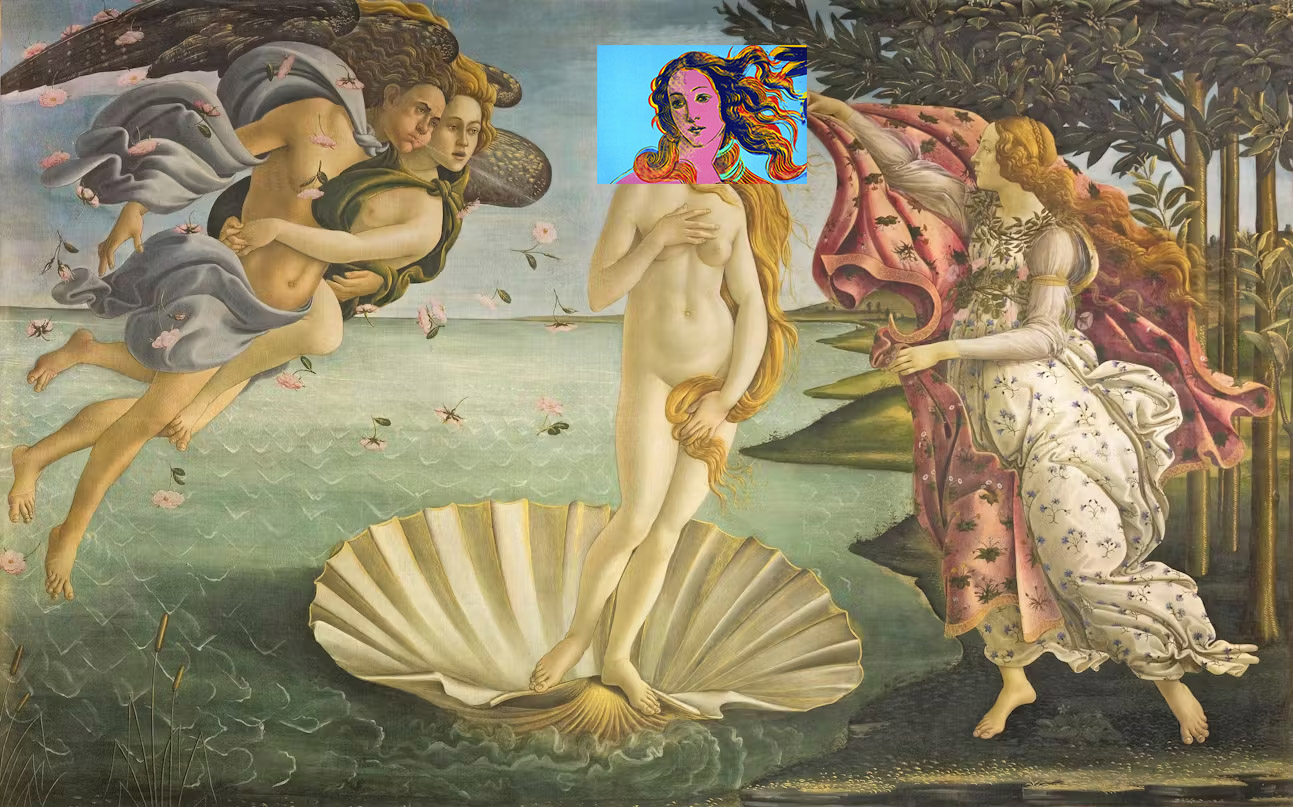
Given my career experience of defending an artist who makes copies, I immediately felt sympathy for Nicholas Lochoff (1872–1948). For years, I have worked at The Andy Warhol Museum, devoted to a world-famous artist who often faced criticism for making “copies” of pre-existing images from pop culture. This past semester, I took Curatorial Development and worked alongside other Pitt students to research the best ways to revitalize the Nicholas Lochoff Cloister in the Frick Fine Arts Building. In studying Lochoff, I learned about an obscure artist who made a career as the top “copyist” of 14th and 15th-century Italian art, and often found his works undervalued for their status as “mere copies.” Both Andy Warhol (1928–1987) and Lochoff ended up copying the same Italian masterpiece, Sandro Botticelli’s The Birth of Venus (c. 1484–1486), but their approaches differed in almost every conceivable way. Comparing the artists’ two distinct methods can illuminate the many nuanced decisions and creative choices that go into reproducing or reinterpreting an iconic painting from art history.
Nicholas Lochoff was born in Pskov, Russia in 1872, and his artistic career began when he moved to Florence, Italy in his mid-thirties. Andy Warhol was born in Pittsburgh, Pennsylvania in 1928, moved to New York in 1949, and achieved fame when he exhibited his Campbell’s Soup Cans in Los Angeles in his mid-thirties. If you want to see the largest quantity of paintings by Lochoff in a single space, go to the Frick Fine Arts Building on the University of Pittsburgh campus in Oakland. If you want to see the largest quantity of paintings by Warhol in a single space, go to The Andy Warhol Museum on the North Side.
Warhol sometimes gets called a “Renaissance Man” because he worked in drawing, painting, printmaking, photography, sculpture, installation, music, publishing, film, video, television, archiving, and collecting. He was the ultimate man of his time, fully immersing himself in 20th-century pop culture. Lochoff was a different type of “Renaissance Man,” in that he painted with the materials and techniques of a Renaissance artist. He probably would have preferred to live during the Renaissance himself, perhaps equipped only with the foresight to know how 15th-century varnishes would darken over time. Rejecting modern approaches to artmaking, Lochoff thoroughly researched each artist he aspired to emulate and, using his education in chemistry, made his own paints and tools by hand based on his findings.
Both artists created their own versions of Botticelli's painting, but neither made an exact facsimile. Lochoff painted only one copy of The Birth of Venus over the course of eighteen months, around the same amount of time Botticelli would have spent on the original. Warhol painted and printed over two hundred copies over the course of 1984, alongside dozens of other projects, with the help of his team of silkscreen printing assistants. Lochoff’s reproduction is almost the same size as Botticelli’s original. Warhol made substantially smaller paintings on canvas and prints on paper. Lochoff adopted Botticelli’s use of tempera. Even though Warhol had actually made over 150 artworks with tempera, for his series of Birth of Venus paintings and prints, he used his usual acrylic paint and silkscreen ink.
Lochoff preferred the term “reconstruction” over “copy,” considering it a more accurate descriptor of his process and intention. He idolized the Italian artists of the quattrocento and paid tribute to them by creating reconstructions that, by virtue of being 600 years younger, would outlast the originals. He lamented the deterioration that these artworks had endured over the centuries and believed that reproducing them would help make them more accessible to future generations. For him, each recreation of a Renaissance masterpiece was a painstaking labor of love. Lochoff strove to make his reconstructions look as accurate as possible, although his definition of “accuracy” entailed factoring in how he believed the original would have looked back in the 15th century. Multiple reports claim that he spent six months adding discolorations to The Birth of Venus to reflect the ravages of time. Still, his reconstruction appears fresher and more vibrant than the current state of the original Botticelli. Venus’s skin is paler, making her orange hair look brighter in contrast. Lochoff also used a cooler shade of blue when he painted the sea, while the blue of the sky appears identical to the original. Most noticeably, he declined to use red or pink tones in his rendering of the cloak that the Hora of Spring holds up to Venus. He replicated the floral print on the cloak with the utmost precision, but left the cloak itself an inexplicable clean white.
Warhol painted The Birth of Venus as part of a larger series of Details of Renaissance Paintings, commissioned by European print publishers. While he knew of Venus, he complained that some of the other paintings his clients suggested weren’t famous enough. The publishers explained to him that some of their choices were more famous in Europe. He grumbled about the project in his diary: “The Details. I hate them. Like details of the Botticelli ‘Venus.’ But people are loving these best. It makes you wonder.” He made several radical moves to transform a recognizable Botticelli into a recognizable Warhol. First, he cropped it drastically, removing Venus’s less-famous friends and focusing only on her face and flowing hair. Each artwork has at least three layers of silkscreen prints based on photographs of copies of the original. Warhol also added another screenprinted layer of a line drawing he drew in pencil, which outlines the goddess’s facial features and strands of her hair. In one of his paintings on canvas, Venus’s skin is bright pink, and her hair is midnight blue with fiery red and yellow highlights. In some of the prints on paper, her skin is jet black with dark orange shadows; in other prints, her skin is Tiffany blue. In two versions of the prints, Warhol used a much more naturalistic skin tone, but he never aspired to replicate the exact shade of orange that Botticelli had used in her hair.
Suffice it to say, the artists had two different attitudes about Botticelli and took very different approaches in reinterpreting The Birth of Venus. However, both artists effectively brought this fifteenth-century painting into the twentieth century. In the end, they also both brought this painting out of the Uffizi Gallery in Florence. Neither version settled in Pittsburgh until after the artists’ deaths; but even if Pittsburgh wasn’t their first intended destination, both artists wanted to make The Birth of Venus available to see without a trip to Italy.
When comparing Lochoff and Warhol, we must acknowledge Lochoff’s sincerity versus Warhol’s cynicism. Lochoff recognized The Birth of Venus as a masterpiece that he felt an obligation to salvage. Warhol recognized The Birth of Venus as a commodity that would sell well in the 1980s art market, sending the message that masterworks of art history, like cans of Campbell’s soup, are products meant to be bought and sold. But both reinterpretations produce the end result of making The Birth of Venus more accessible to wider and younger audiences. Both artists tapped into the time-honored tradition of copying the “masters,” but each with their own ideas around authenticity, accuracy, and authorship.