
Author: Camila Aguayo
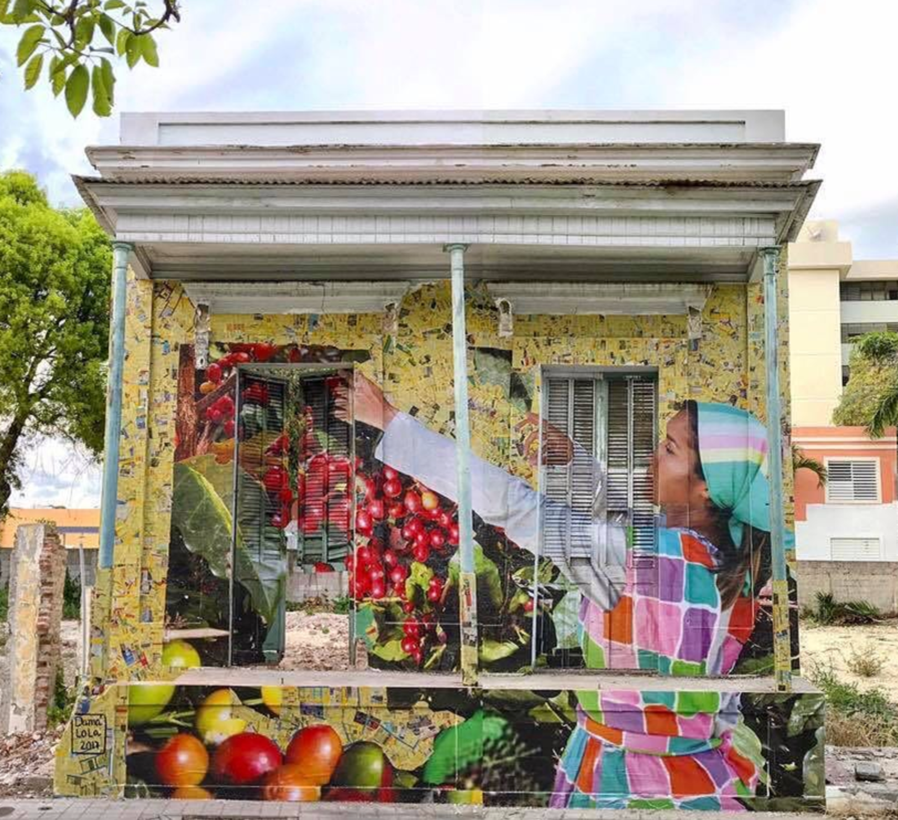
Damaris Cruz, Recolectando la Semilla, 2017, Calle Aurora, Ponce, PR.
Memory is something the majority of us take for granted. We often assume it is inherent to our human nature, readily available whenever we seek its help. Yet, memory plays a crucial role in the lives of those who have been rendered invisible and cast into obscurity by systemic neglect. Inherently, there is discontent in the collective memory we hold over the spaces we have given meaning to, transforming them into sites of contestation where alternate narratives emerge. In these spaces, the act of re-remembering becomes a tool to challenge the dominant ideologies that have shaped and reinforced the very power structures that formed our understanding of place. It serves as a sociopolitical device that disrupts networks of oppression and brings forth hidden spaces filled with agency. With memory, there is an opportunity for a radicalization and imaginative reconstruction of space that can build sites of potential transformation.
Over the course of this semester, I had the opportunity to be part of a History of Art and Architecture graduate seminar that helped me reimagine the role memory plays in shaping our identity with the built environment. Centered around the constellation of Space and Place, each module revealed new ways in which lived experiences and collective memories influence the material spaces we occupy. Essentially, we laid out how our relationship with the environment is both material and mental, tangible and intangible. As presented in the different modules, and as I learned throughout the semester, put simply, through memory and the built environment there is a reclamation of place, culture, and identity. The spaces we inhabit are not just physical, neutral vessels, but repositories of remembrance that carry in them different stories and truths. To understand the complex layers of struggle and resistance embedded in our urban fabric is to use memory as a transformative force – one that will reshape how we experience and find belonging in the spaces that surround us.
With this new lens of spatial memory and placemaking, I think back on my own understanding of spatialized identity in Puerto Rico. On the island, we live with an institutionalized myth of racial harmony, one that implies a seamless coexistence between communities that completely ignores the complexities of their contested histories. Despite this myth, Puerto Rico’s built environment and social geographies have silenced the lived realities of the island’s Black communities by using architecture as a weapon to marginalize and render people invisible. How can these same structures of oppression be used to give voice and reclaim space? In what ways can architecture change its role as a silent witness to be used as a mnemonic device that reifies the past?
Damaris Cruz, known by her artist name Damalola, works with the memory of everyday life, often intervening in obscure spaces unknown to many. As she appropriates and transforms different architectural structures, she reinserts the legacies of Afro-Puerto Ricans in the urban imaginaries of the population, serving as a powerful counter-narrative that challenges the spatial objective truths embedded within the built environment of Puerto Rico. In her mural, Recolectando las Semillas, she transformed a Creole house, made for the white working class of the island, into a new architectural space that centers Black histories and geographies that have been erased from the urban landscape. Though the mural itself was destroyed by a series of earthquakes, its impermanence underscores the role of remembrance – to keep alive histories physical spaces tend to erase. Here, memory serves as a catalyst to challenge hegemonic power structures and create new places of liberation. By reimagining the potential transformation spaces hold, memory becomes a tool that challenges the white urban imaginaries we have become accustomed to. Spaces once complicit in perpetuating oppression now become sites of empowerment and release. It is important to remember that memory is not just a recollection of the past but a force of social change that can dismantle and reimagine the built environment into a landscape of possibility.