
Author: Emma C. Roberts
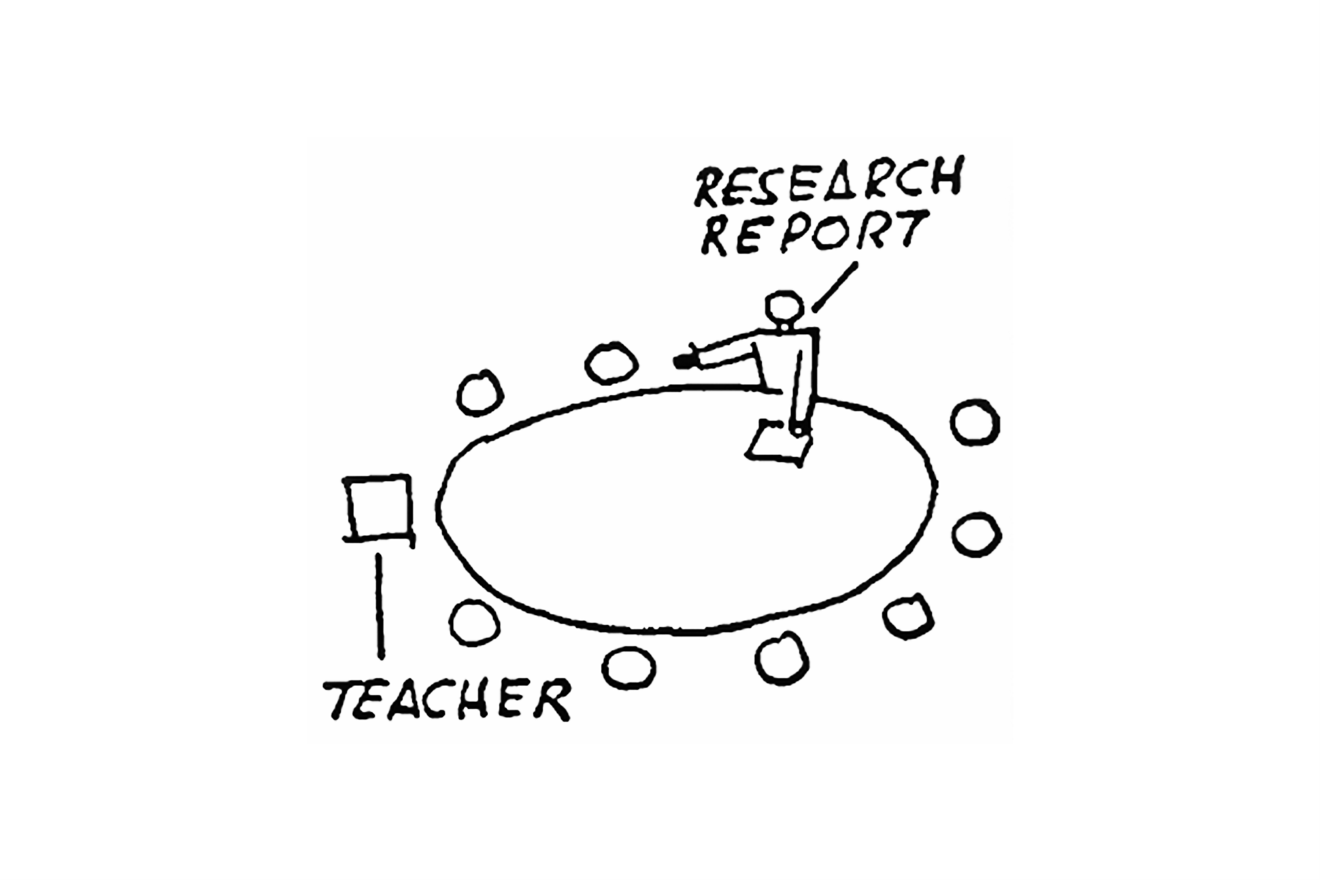
From Paul Goodman, Utopian Essays and Practical Proposals (1962).
During the spring of 2024, I was a member of the graduate seminar Space and Place: Topographies of Power and Resistance. The seminar consisted of three concatenated modules, each addressing diverse temporal and geographic contexts, all linked by their interrogation of spatial concepts. Despite our focus on space, we dedicated little attention to the spatial dynamics of the room we gathered in weekly over fifteen sessions. During these meetings, discussions frequently returned to social and spatial dynamics: How are social identities spatially constructed and negotiated? How are communities formed and maintained in space? How do individuals and groups exercise agency within oppressive infrastructures? Consequently, in this reflective post, I think it is necessary to grapple with the spatial and relational dynamics of our own seminar.
When I first arrived at Pitt in the fall of 2023, the seminar room featured two long wooden tables arranged in a T-shape, with the table forming the crossbar of the T positioned slightly higher than the one serving as its stem. A few weeks after I arrived, the tables were replaced by modular units, with each rectangular module fitting two people. These small mobile tables offered flexibility for faculty and students to reconfigure the room’s seating arrangement according to their needs. However, the replacement of the timeworn chestnut-stained tables with corporatized laminate-top desks caused consternation among some of the room’s regular inhabitants. After a series of collaborative reconfigurations, the units were ultimately moved into a square formation, and they have since remained fixed.
In his essay “Seating Arrangements: An Elementary Lecture in Functional Planning,” Paul Goodman argues that no activity has a single functional arrangement. Seating configurations “must inquire into the essence of the activity, its purpose, technique, and site” (Goodman, 156). The seminar is most often held around an oval or circular table. This is what distinguishes the seminar from the demonstration, the recitation, or the lecture, where seating caters to a unidirectional flow of information from the authority to the taught. In Frick 104, the square strives toward the unobstructed visual contact enabled by the oval or circular table. Goodman writes of the seminar in-the-round: “Obviously this is not an arrangement for indoctrination or briefing, but for the presentation of fledgling research, reading papers, and hearing criticism from one's peers, under expert guidance” (Goodman, 172).
Each week, as we filtered into the room, some members habitually returned to seats they had developed a preference for. For some, this meant a direct sight line to the window. For others, situated toward the screen—a feature of the seminar room not accounted for in Goodman’s analysis. Almost always, the seminar leaders positioned themselves at the front of the room. In dialogue with my peers, we discovered that many of us returned to the same seat week after week because we feared that, by choosing a new seat, we would be displacing someone else. As we navigated encounter, exchange, interaction, and care across diverse intellectual terrain, we navigated relations in the seminar room, though they went largely unnamed and untheorized.
In “To the Seminar,” Roland Barthes describes a site where knowledge meets desire, a subtle and flexible force that circulates around the seminar room. The objects of desire, “fragments of knowledge, dreams of method, snatches of sentences,” are transmitted by inflected voices (Barthes, 335). In turn, knowledge relaxes. According to Barthes, the seminar unfolds within three interconnected spaces: the institutional, the transferential, and the textual. The institutional pertains, naturally, to the institution, which dictates the frequency, schedule, and location of the seminar. The transferential concerns the dynamics between the seminar's members and directors, who cultivate an environment conducive to horizontal transferences–the exchange of knowledge between members. The last space, the textual, refers to what the seminar produces, whether in a written text or in an acknowledgment that the seminar itself constitutes a text.
The seminar’s work, for Barthes, is the “production of difference” (Barthes, 334). During our Space and Place seminar, the shift between modules punctuated the presence of difference. As the relationships between the seminar director and membership transitioned every four weeks, the seminar group performed a great deal of self-maintenance. We embraced each other’s distinct sub-disciplinary investments and personal histories. Each relation formed was made original. As Barthes writes, each relation “discovers the originality of bodies taken one by one, breaks off the reproduction of roles, the repetition of discourses, counters any staging of prestige, of rivalry” (Barthes, 334).