
Author: Celeste Smith
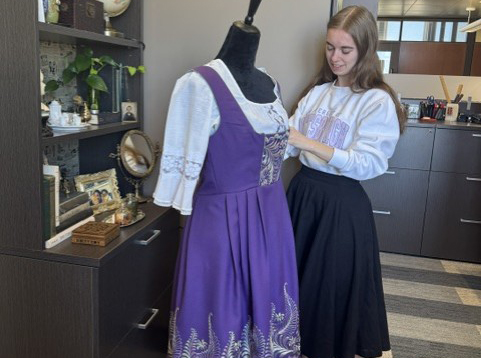
The collection associated with the Nationality Rooms has the magical ability to connect visitors with cultures from around the world, and that’s especially true of the national dresses that sit in a closet on the second floor of the Cathedral of Learning. Behind an unsuspecting door lies shelves and racks of donated traditional dress waiting to be put on showcase, and this semester’s collaboration between the Nationality Rooms and Intercultural Exchange Programs and the university’s Open Lab gave me the chance to do just that. We were a small team of four: Mona Wiley, Associate Director of the Nationality Rooms and Intercultural Exchange Programs, Daniel Kaple, Digital Creation Specialist for the University Library System, Jeffery Shellenberger, fellow intern, and me. Our collective goal across the semester was to create 3D scans of objects from the Nationality Room collections so that they can be used to improve digital showcasing, and I took on this often-hidden costume collection.
3D scanning the costumed mannequins was actually one of the easiest parts of the process. The Open Lab provided us with a LEO scanner, which captured every outfit beautifully with just a slow walk around the mannequin while moving the scanner up and down— even the most complicated outfits I staged created perfectly detailed 3D models. In comparison, getting an outfit ready for scanning required numerous preparatory steps: select garments by cross-referencing the collections catalog and my preliminary research, transfer storage boxes from the costume closet to the staging site, conduct in-depth research on correct styling, and finally, dress the mannequin.
Still, all that work was worth it to see history reanimated right in front of me every time I completed the finishing touches and stepped back to look at the transformation a mannequin had undergone. Some of the outfits assembled themselves quickly, such as the Polish outfit. It was part of the first set pulled from storage and staged for scanning and as I layered on each garment, I felt a growing connection to my own Polish heritage. This is what the Nationality Rooms and Intercultural Exchange Programs are all about— letting students and the Pittsburgh public engage with international cultures without having to travel.
Other objects involved considerably more work and frustration, such as the Japanese kimono. The Japanese Nationality Room costume collection contains many different kimonos for both men and women, each and every one beautiful in its own right. I knew I wanted to create a scan of one of these, no matter how hard it was to set up. More research than usual went into getting ready to stage the outfit, yet it still wasn’t enough to prepare me for tying an obi around an unwieldy mannequin with no way to secure it when transitioning between steps.
Even after all that, I am not entirely sure that I got it all right, and we have decided to forgo uploading that specific scan until we can confirm the cultural accuracy of its digital representation. Still, the trial and error that went into tying the obi made the final result something to just step back and admire, which I think sums up how I felt at the end of my internship. The work I did with the Nationality Rooms and Intercultural Exchange Programs and the Open Lab was new and always changing, but that made the final 12 3D models produced using the Nationality Rooms’ costume collection something to be even more proud of. As the program continues across future semesters, the Nationality Rooms tour app will slowly be populated with links to the 3D models produced by myself and other interns and I’m so excited for the general public to be able to admire these beautiful traditional outfits the same way I have for the past few months.