
Author: Rebecca Lowery

What does it mean to translate something? And what does this have to do with space and place?
The initial question that I posed may seem self-explanatory. Maybe you didn’t even hesitate as you thought, well, it is a question of language. If I want to talk to someone who speaks a different tongue, I decide what I want to say, go to a dictionary, and translate. And absolutely this is one way to understand the term: translation as predicated on the search for linguistic equivalence. Yet this is an impossible task. So goes the Italian phrase, traduttore, traditore. Translator, traitor. However, the word play that is so evident in the Italian is lost when presented in English. To translate is to betray. In this blog post, I would like to linger on how the unequal exchange inherent in translation, which the example of traduttore, traditore makes explicit, can be a productive point of inquiry for discussions of space and place.
The need for linguistic translation often emerges from geographic distance, the very fact of being in a different place. But translation is also the act of moving something from one place to another. This is discernable in the etymological origins and corresponding resonances of translation. To translate comes from the Latin trans-, “across,” and -latio, the past participle of “to carry, bring.” The image below is a representation of this latter signification of translation.
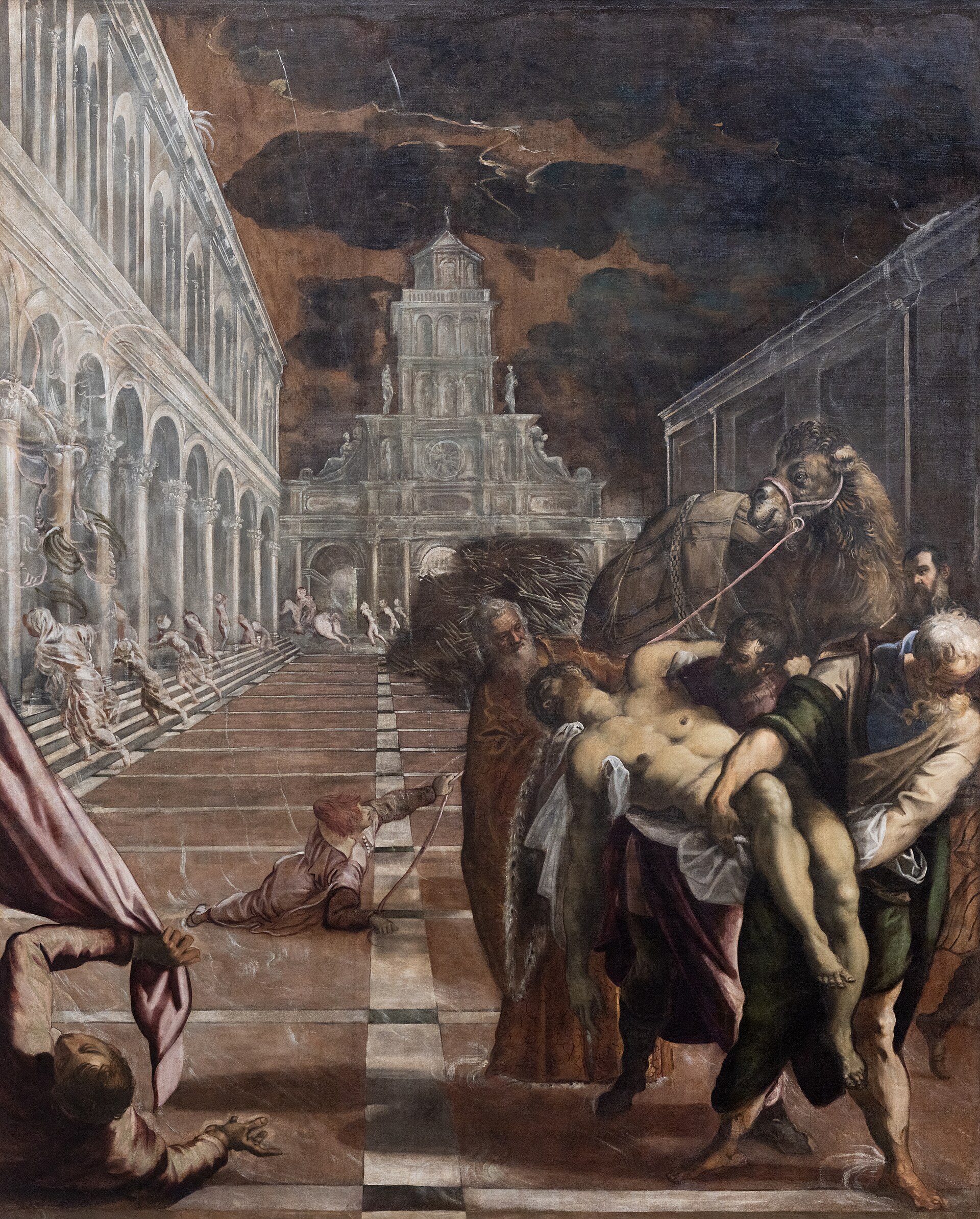
Image citation: Jacopo Tintoretto, The Removal of the Body of Saint Mark, 1562-1566.
In 828 CE, Venetian merchants took the remains of Saint Mark from Alexandria, Greece (where he was martyred in the first century) and smuggled them to Venice–a translation of his relics. In this context of physical movement, translation becomes all the more a space-oriented term that allows for a recognition of difference as emerging from a change in place. But this difference is founded on a false exchange, one side benefits more than the other. The translation of Saint Mark’s bones upholds the act of betrayal conveyed by traduttore, traditore. Although the Venetian people maintained that the move was preordained, it was ultimately an act of theft. In their smuggling, the Venetian merchants deceived the Egyptian officials by hiding Saint Mark’s remains under pork. To translate is to betray, to deceive. The adversarial resonances of the whole situation are heightened in Tintoretto’s painting by the people in the background fleeing from the dark, ominous sky and the layer of water that sits at their feet. Perhaps as a testament to this very recognition of place (and change of place) as inherent to translation, Tintoretto has painted a camel in the foreground of the scene. The camel’s lead cuts behind Saint Mark’s head, an overlay likely invoking his initial resting place in Alexandria. But the background of the painting is distinctly Venetian, a characterization emerging from the intricate arches of the two-story colonnade and church façade as well as the multicolored geometric pavement that recedes into space.
As part of my inquiry into translation and the unequal relationships and corresponding loss that a definition begets, it is worth considering what “distinctly Venetian” as a place marker means. Venetian style is in part so recognizable because it integrates Byzantine and Islamic forms. This is in itself an act of translation, bringing the “foreign” into an Italian architectural vocabulary of classical arches and columns. The incorporation of ornamental elements into the Venetian built environment is attributable to the maritime Republic’s trade networks. The white building facades, as well as the pairing of white and red stone on the pavement, are further indications of these networks which simultaneously locate the painting in Italy. Venice is a compendium of islands in the middle of a lagoon, meaning that the only natural resources that directly surrounded them were salt water and fish. The stone, in other words, had to come from elsewhere. And indeed, the white that Tintoretto renders is likely Istrian stone, a white limestone that came from the far reaches of the Venetian empire in what is now Croatia, and the red is conceivably broccatello from near Verona. The stones, the camel, and the body of Saint Mark, when taken together and understood through the lens of translation all convey a statement about the wealth and power of the Venetian empire. As markers of place, they intimate translation as a nonsymmetrical act of exchange.
In all of this, I would like to conclude with a consideration of the role of the individual in making place. Painted to the right of the camel is an unassuming man with a beard. This figure is often presumed to be a self-portrait of the artist. More than seven centuries removed, Tintoretto positions himself as witness to this foundational event in Venetian history. However, it is with understanding Tintoretto as a Venetian, creating a work that was commissioned for a Venetian Church, the Scuola di San Marco, we are reminded of the embodied perspective in matters of translation. Translation is an act of power, but it is not always on the level of hagiography. If we return to my point of departure, translation also operates on a very personal level, between two people trying to find common ground and a way to communicate. Ultimately, a place-based conception of translation allows for a reconsideration of how we view the world and how we conceive of relationships to those around us.