
Author: Anya Hammer
My introduction to the Worcester Art Museum as an intern began in the photo room crammed with white backgrounds, wires, and lights, all centered around a remarkable suit of chainmail Mughal armor. The duo-toned chainmail was unlike anything I've ever seen in my non-existent time working with arms and armor before this past summer. Affectionately nicknamed Link, this is one of the many full-body suits that will be featured in the opening of the new Higgins Arms and Armor Gallery in November 2025.
In recent years, more and more museums and artists are embracing the concept of an ‘open archive’, allowing visitors a more transparent and interactive experience with the objects themselves. As one of the largest collections of arms and armor in the world, the Worcester Art Museum has been working on an open archive gallery to house these objects. While I was working there, I had the opportunity to catch glimpses of the progress as well as directly contribute by writing labels, demonstrating the donning of Japanese and European armor, cleaning objects, and helping with the creation of a flipbook with interactive learning on objects in the gallery.
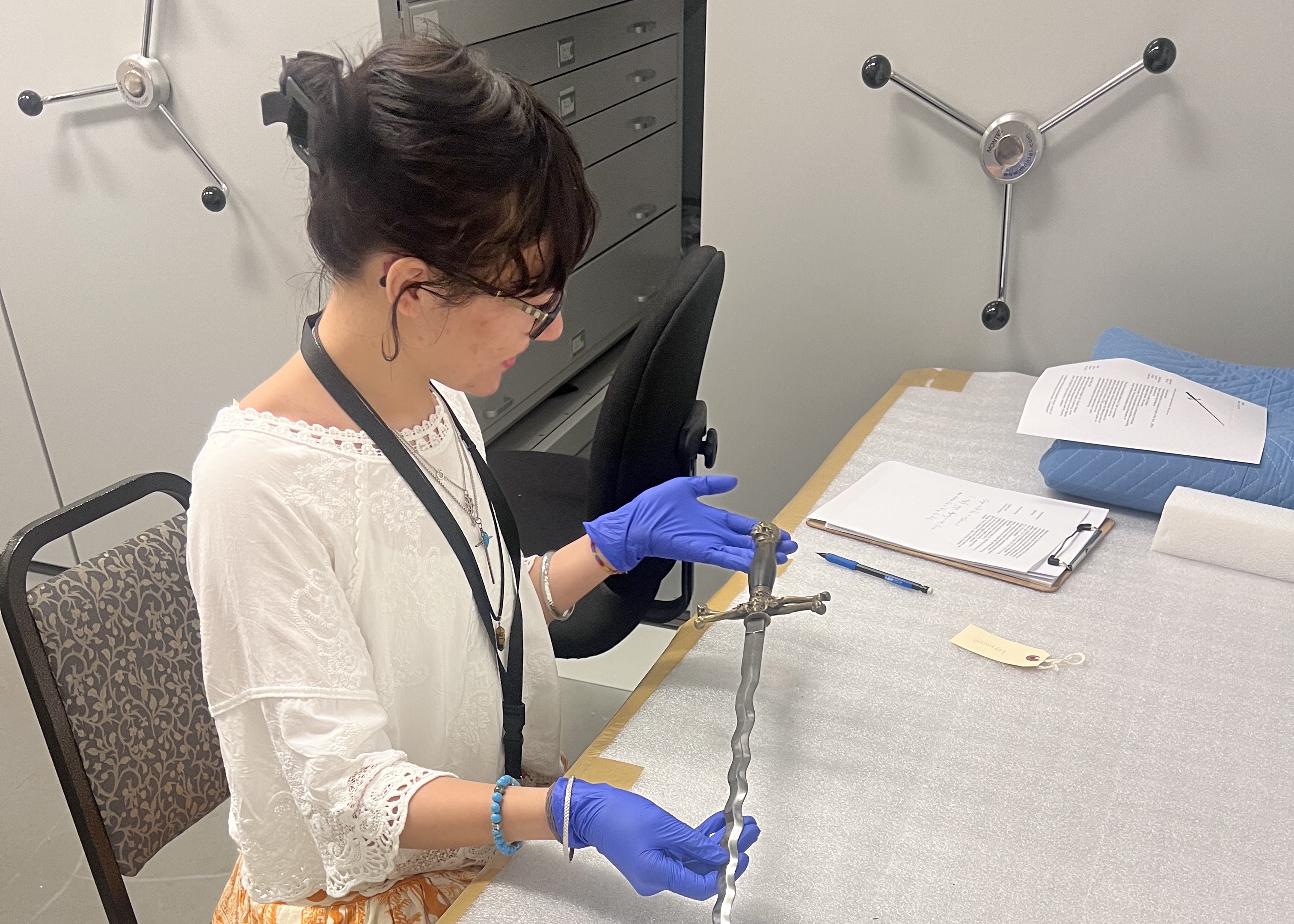
In the basement of the museum, I stood in the cold storage room crammed with drawers, boxes, and rolling shelves filled to the brim with swords, helmets, spears, firearms, and entire suits of armor. Despite being surrounded by hundreds of fascinating objects, I found myself returning to this one sword with a wavy blade, a crossbone guard, and a skull pommel. When learning that each intern had the opportunity to choose an object from the collection to research, I immediately hunted this sword down. Labelled as a Ceremonial Sword for a Consistory Knight of the Sun, 28th Degree, Scottish Rite of Mason, this sword belonged to a member of a Freemason’s fraternal society. I scoured books on fraternal swords, ordered reprints of sword catalogues from the late 19th century, and communicated with Freemasons to find more insight on this sword. Due to my research, I was able to rewrite the sword’s label, attribute it to a French sword maker, and place the creation time fifty years later than originally thought.
I am forever grateful to the Worcester Art Museum for allowing me to have this experience that cemented my decision to be a museum curator. Day after day, being surrounded by beautiful objects and people who share the same values for preserving history has been a privilege that I hope to experience for the rest of my life. When the gallery finally opens in November, I’ll have the chance to see the sword I researched in its own display case with my name on the label.
Anya Hammer was a Summer Intern at the Worcester Art Museum, supported by a Tomayko Foundation Summer Internship Grant.