
Author: Saige Rucker
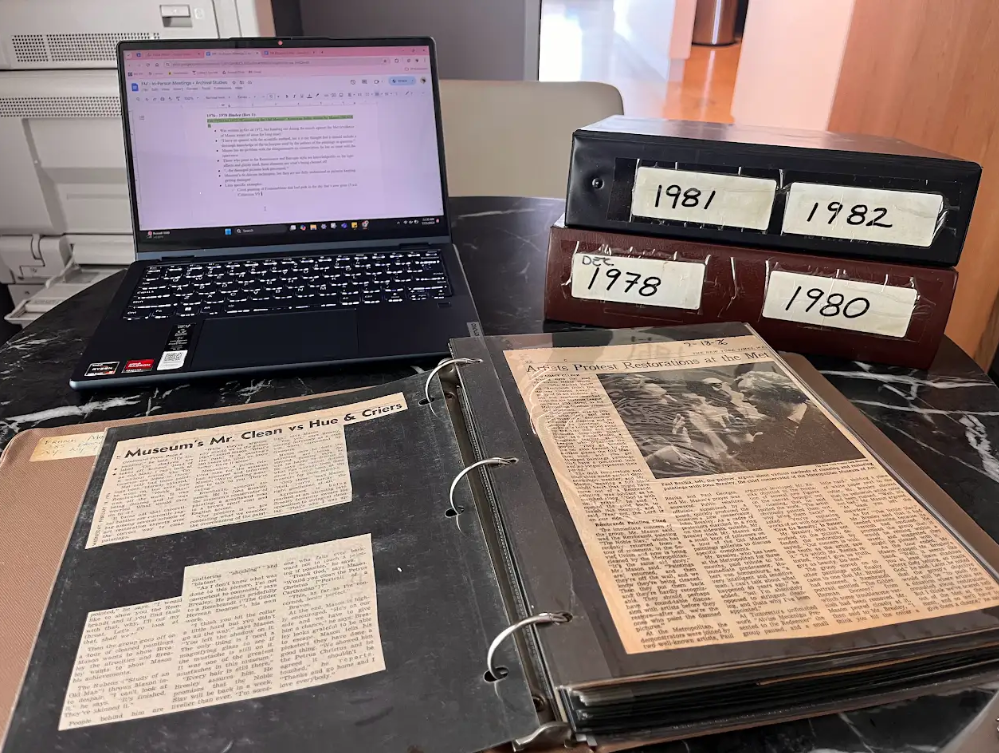
On February 18, 1976, painter Frank Mason (1921-2009) led a group of around fifty protesters to the steps of New York’s Metropolitan Museum of Art. One might guess that their complaint concerned the museum’s political stance, or perhaps the exclusion of contemporary art from an exhibition. But the motivation for this march was more unlikely, as the group was protesting the museum’s approach to cleaning and conserving Old Master paintings.
This is one of several cases where Mason decried what he regarded as too extreme cleaning procedures. In the case of the Sistine Chapel, Mason had even written to the Pope to complain of the actions of the project’s restoration team responsible for cleaning Michelangelo’s frescoes.
Why was Mason so passionate about this issue? One reason concerns the latter of the two scenarios, in how the ceiling’s cleaning was marketed. The cleaned sections were often referred to as the “new” or “real” Michelangelo and the project’s head restorer, Gianluigi Colalucci, as well as other supporters, publicly implied that the previous understandings of Michelangelo needed to be re-evaluated. Mason’s entire practice was built on his studies and prior knowledge of the Renaissance and traditional techniques, it is no surprise that altering such perspectives would prove to be a huge shock.
This history has been the focus of my summer research fellowship supported by the Tomayko Foundation, for which I have been able to look closely at the paintings by Mason on display in the foundation’s Bloomfield gallery, and explore privately held archives about the artist’s work and life.
These archives consisted of two boxes full of binders containing newspaper clippings, letters, certificates, and much more. I sifted through and studied all of these records, allowing me to trace Mason’s life from the early 1920’s, up until the year he died. Mason mainly painted murals, portraits, and landscapes earning him worldwide recognition, commissions and awards. His painting style was traditional, drawing upon the techniques of artists such as Rubens, Rembrandt, Velasquez, and Titian. He studied these artists’ methods and utilized them himself, making it his mission to preserve their techniques. In his efforts to maintain these ideals, Mason was also an instructor at New York’s Art Students League (ASL), sharing his knowledge with upcoming generations of artists.
Driven by his own commitment to preserve the past - both its particular techniques and its general appearance - Mason’s campaign against the cleaning of Old Master paintings defined much of his later career. He continued to paint and teach the way he always had and went on to co-found the organization ArtWatch International to further his efforts to monitor museum conservation practices. Mason was a talented artist and deserves much credit for all he accomplished, even beyond his conservation efforts. Given that Mason’s records are held privately, further research and cataloging can open new pathways for exploring other aspects of his life and his art.
Saige Rucker was a 2024 Tomayko Foundation Summer Research Fellow