
Author: Lindsey Kenny
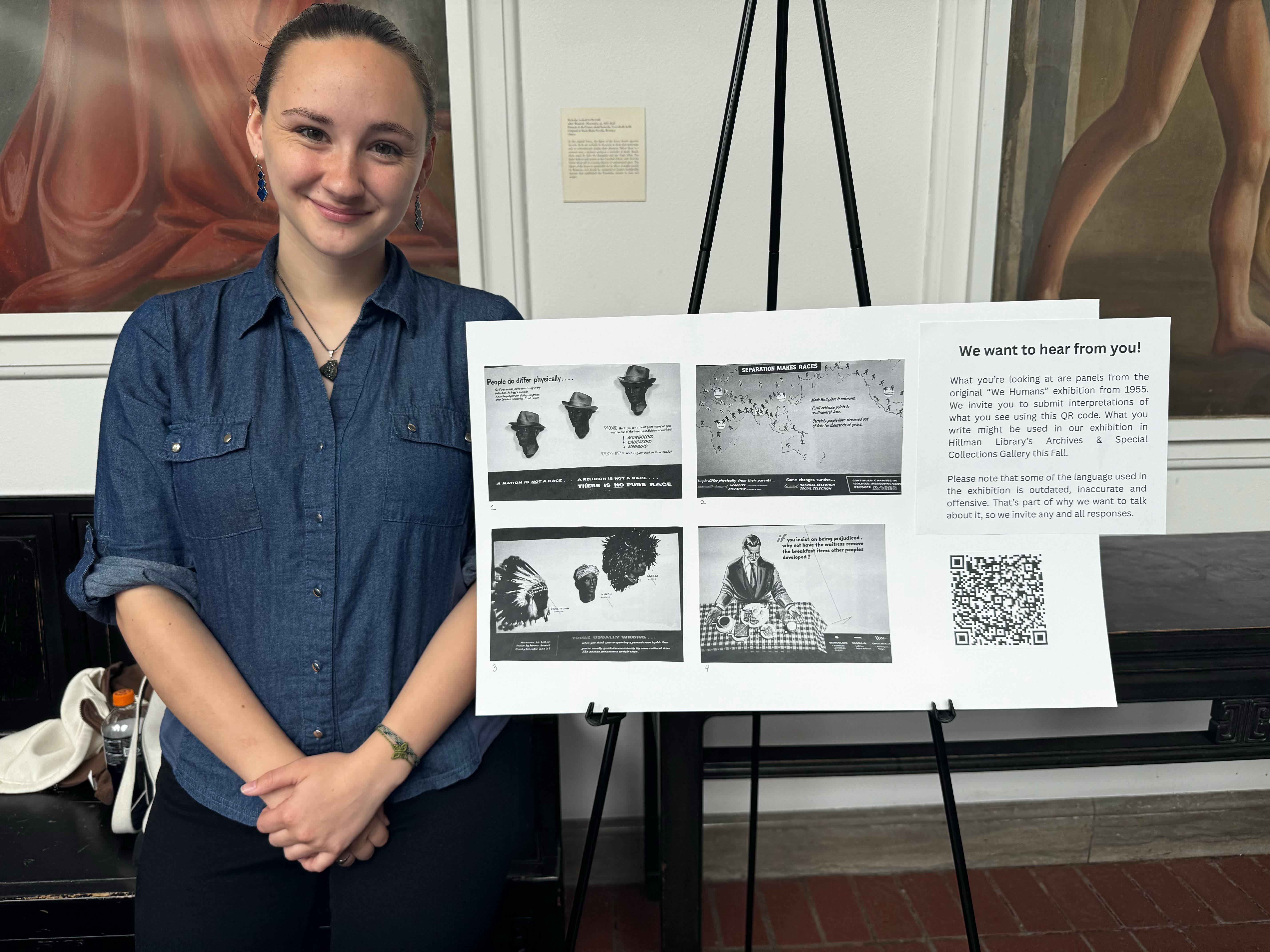
Imagine yourself standing in front of an exhibit at the Carnegie Museum of Natural History. Images of Indigenous people in elaborate headdresses, a grinning man sitting down at a dinner table, and world maps all jump out at you. The headline of the exhibit reads, “We Humans.” These panels all come together to describe the inner workings of race and racism, and how, societally, people aren’t different after all. Given twenty-first century museums’ recent drive to promote diversity, equity, and inclusion, this may all feel like a regular trip to the museum. But what if I told you this scene is actually one from the 1950’s?
Throughout the course of my internship with Dr. Deirdre Smith, who works both at the Carnegie Museum of Natural History and as a professor at the University of Pittsburgh, I became familiar with the 1955 exhibit “We Humans” and its associated curriculum. I conducted background research on the events leading up to the traveling exhibitions in order to help Dr. Smith design and curate a seventieth-anniversary exhibit in Hillman Library titled, “We Humans at 70.” Taught throughout Pittsburgh Public Schools and at steelworkers' meetings, “We Humans” was a series of panels designed to educate Pittsburghers about race and racism with the intention of reducing prejudice throughout the city. The panels were intentionally eye-catching, with giant phrases like, “You’re usually wrong…” heading smaller explanations dismantling particular assumptions about race, such as certain racialized diseases, and cultural iconography like intentionally “exoticized” clothing and accessories. Overall, the project was incorrect and biased in certain ways – for example, insisting upon the idea of there being three main races, though urging viewers to see all three as equal – but it was also quite progressive for the time and place, and I found it to be an incredibly fascinating glimpse into Pittsburgh’s history… one that I believe more people should learn about.
I found myself focusing particularly on the community aspect of the project. I wanted our exhibit to really impact people, more than it might if they just glanced at an object or two on their way to read about something else. I designed flyers and planned to reach out to senior centers and community areas in southwestern Pennsylvania. I even asked my own relatives from Pittsburgh to see if anyone had any memory of “We Humans.”
I didn’t track down anyone whose memory made it possible to capture the historical experience of audiences with this display. But thinking through this problem prompted Deirdre and I to use HAAARCH!!! (the University of Pittsburgh’s undergraduate research fair for the History of Art and Architecture Department) to consider audience reactions in a contemporary context. Putting a unique twist on my tabling session, Dr. Smith and I put together a poster of a few of the panels from the original “We Humans,” designed a Google Form, and printed out more of my flyers. I included some of the wall labels I wrote that will be part of our “We Humans at 70” exhibition, for further explanation. I spent the day of the fair calling people over and inviting them to read more about each of the panels, asking them what they thought, and encouraging them to respond to the prompts in the Google Form.
We have lots of work yet to come, but our hope is to make “We Humans at 70” a truly interactive exhibit by selecting a few of these community members’ answers and putting them in our exhibit as the wall labels themselves. I’m so proud to have been a part of this project, and when the exhibit debuts in September of 2025, I’ll be happy to know it is part of the community, by the community.
We all have our own internal biases and preconceived notions – this fact has unfortunately not changed from the 1950’s to now. But it’s what we do to acknowledge these prejudices and better ourselves and the world around us that truly makes a difference.